
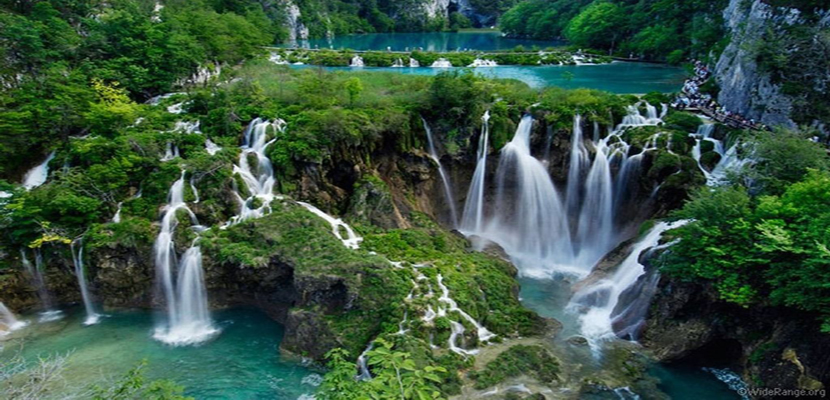
Croatia boasts eight national parks, but one of the most striking, renowned for its unique landscapes, is Plitvice Lakes , recognized as a UNESCO World Heritage Site in 1979. This collection of lakes, waterfalls, and streams, surrounded by lush vegetation, is also a UNESCO World Heritage Site and is considered one of the most beautiful natural landscapes in Europe.
The Plitvice Lakes are in the Lika region of central Croatia and very close to the border with northwestern Bosnia. To visit them, it is best to drive to the nearby town of Plitvicka Jezera, located next to Lake Kozjak, which can be traveled on foot through paths and wooden walkways or by boat and with special electric vehicles.
There are many routes and walks to explore in the region, as this Natural Park boasts thirty thousand hectares to get lost in. These are divided into two main areas. On one side are the twelve upper lakes (which are the largest) , and on the other are the lower lakes , located in an Upper Cretaceous canyon where Lake Milanovac, Lake Gavanovac, and Lake Novakovića Brod stand out, the latter featuring a spectacular 78-meter waterfall.
The upper and lower lakes have different characteristics. While the former boast crystal-clear waters and are surrounded by lush vegetation, the latter are part of a more rugged landscape in the heart of a canyon where only small shrubs grow. The waters of the lower lakes are the ones with the spectacular turquoise color that visitors love. Furthermore, it is in this area that Croatia's largest waterfall and one of the park's most famous caves, Šupljara Cave , are located.
Plitvice Lakes National Park receives more than 1.200.000 tourists a year and is home to a large number of birds as well as other animals such as the European brown bear or the lynx.
Plitvice Lakes is open to the public from 08:00 a.m. to 18:00 p.m. every day of the year. Ticket prices are as follows: €23,5 for adults, €10,4 for youth, and €14,5 for students. Children under seven years old enter free.